

The leader and the person are indistinguishable.
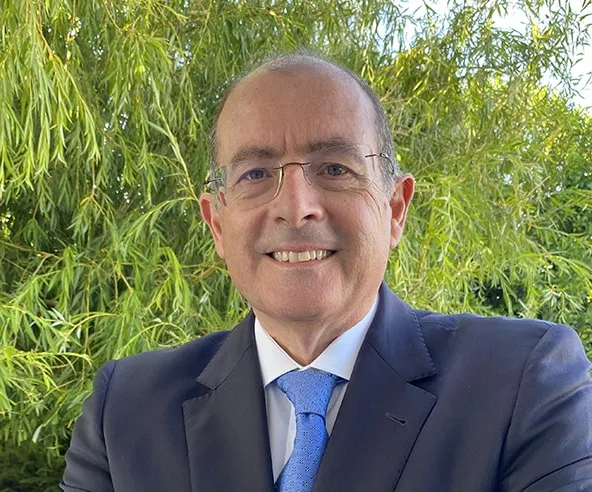
“The leader and the person are indistinguishable.” This is said by Alexandre Portugal, who by taking the PADE – Senior Management Program for Companies, “settled and arranged” concepts and procedures in his life as a manager. Responsible for coordinating a relevant part of the construction of the Vasco da Gama Bridge, the COBA Administrator highlights the definition of worsts and a sense of humor as fundamental factors in his life, guided by values such as loyalty, commitment, ambition and trust.
What are the main milestones in your professional career, which contributed to reaching the position of COBA Administrator?
I would mention three fundamental moments.
The first, the training in civil engineering at Técnico. A school of reference, hard and demanding, which transmits knowledge, but above all creates bases for training and resilience, which allow you to address any problem throughout life.
The second moment, at the age of thirty, was the decision to abandon a public career in scientific research to take up the challenge of a career in the private sector. It is a founding moment in the sense that, at least in terms of my perception at the time, security and predictability were exchanged for risk and uncertainty. Probably the most important decision of my professional life.
There is a third remarkable moment, this one already at COBA, which is the Vasco da Gama Bridge project in which, for unforeseen reasons, I am invited to take over the coordination of a relevant part of the project, replacing a much older and more experienced colleague. It is a decisive moment because the challenge was enormous, both because of my age – 32 years old – and because of the complexity of the project, and because of the multinational environment in which it was developed.
If the first two moments were planned decisions, the third was a moment of opportunity. If there is any conclusion that can be drawn, it is that in professional life you have to be prepared for the opportunities that may be presented to you. Being prepared is knowing how to recognize opportunities and having the necessary skills to face them, but also not being afraid and knowing that you grow with these challenges.
What were your main achievements?
More than the specific contributions in several areas to the development of the company – new areas of activity, winning large contracts, organization and methods, international development, etc. – I believe that one of the main achievements will be the recognition by my peers in the company. It was a path made of teamwork, shoulder to shoulder, project by project, in which we have been surpassing ourselves over time and in which individual progression arises as a natural consequence of this path traveled in common.
In-depth knowledge of the business and the sector is also an important asset that allows us to understand the importance of keeping people at the center of concerns. At COBA, people are the alpha and the omega. In an engineering company, far beyond performing the service itself, people embody a critical part of knowledge that is difficult to gather and consolidate into systems or processes.
Perhaps, from a strictly individual point of view, the greatest achievement has been the ability to maintain a balance between work and family life. Naturally, this issue can be seen in the opposite perspective: an adequate balance between family and work is an essential basis for professional success, which is the achievement that results from that …
What are the main lessons that make you the leader you are today?
More than lessons, I think there are some relatively simple guidelines that can be mentioned. The leader and the person are indistinguishable. It is the individual, more or less innate or developed, characteristics of the individual’s character and capacity that determine him as a leader. In this sense, the values of the leader are decisive in the directive action and it must be on them that it is based.
The bases of my work are therefore the values received from the family and professionally throughout life. Naturally, the example of leaders with whom I worked or interacted had an important impact.
In this regard, I cannot fail to mention the impact that AESE’s PADE had on me. It was an important moment that allowed me to stop and reflect on structuring themes of my professional activity and that allowed me to “settle down and tidy up” diverse concepts, practices and approaches of great relevance in my life as a manager.
In a perhaps more direct but very relevant register, and also remembering our late Professor Luís Manuel Calleja, he left three notes: problems are solved by rigor … On a first-come, first-served basis, nothing is as bad as it seems or as good as you want it to be and it is important to maintain a sense of humour in all circumstances.
What values do you govern yourself by and that you transmit to your teams?
I would say that the fundamental values on which I try to base my life are: Loyalty, Honesty, Commitment and Ambition, all in an attempt to build on them the most important thing: Trust.
Loyalty is the fundamental value because it guarantees security, stability and predictability to teams, in an environment of demand and responsibility. Honesty, which can be interpreted here in a broader sense, embracing themes such as seriousness and honesty, is the cement of relationships between good people driven by interest in the common good. Commitment is what allows us to do more together and as a team than we would by the strict sum of individual contributions. Ambition, which I could also refer to as Vision, is what allows us to grow and be greater than ourselves and even what we admit to be.
A motivated leadership with solid values generates trust in its people and it is on this that companies are built.
If you could go back in time, what would you do differently?
He would have done management training earlier. In fact, it was only belatedly, already in management positions, that I attended the AESE program. I think I would have benefited a lot if I had done some training in the initial phase of assuming management responsibilities. I think that especially for those who come from the engineering areas, management training is a strict necessity.
I would have been a better listener in some key moments when I did not always, perhaps also by the nature of my character, listen to or retain important messages with the necessary care. Knowing how to listen is a fundamental characteristic of the manager.
Professionally, how do you see yourself in 5 years?
The speed at which the world we live in evolves makes any attempt at prognosis very risky. In any case, what I think I can anticipate with some confidence is that I will certainly be active, sharing with younger teams the knowledge and experience I have accumulated.