

AESE Team
Catarina Heleno
Manager Executive Education
Learning to decide before deciding
The Case Method, developed at Harvard Business School and adopted by the world’s leading management schools, is at the heart of AESE Business School’s learning methodology.
At AESE, participants do not study answers. They practice decisions.
The Case Method is a pedagogical approach based on the analysis and discussion of real situations experienced by real organizations.
Each case places participants in the role of decision-makers, confronting them with complex problems, incomplete information, time pressures, and real consequences.
There are no pre-formatted correct solutions.
There are decisions to be made, arguments to be supported, and impacts to be assumed.
Practical Learning
Analytical capability in complex and ambiguous contexts
The Case Method trains rigorous reading of situations with multiple variables, incomplete information, and conflicting interests, preparing participants to decide in real contexts of uncertainty.
Critical and structured thinking
Systematic case analysis develops the ability to question assumptions, organize reasoning, and build decisions based on clear and well-founded criteria.
Decision-making under pressure
Cases place participants before time and responsibility constraints, simulating the real conditions under which leadership decisions are made.
Clear and well-founded argumentation
Classroom discussion requires the formulation and defense of solid positions, supported by data, logic, and coherence, strengthening the ability to influence and persuade.
Active listening and openness to diverse perspectives
The confrontation of different viewpoints develops the ability to listen, integrate relevant contributions, and revise positions in light of new arguments.
Sense of responsibility for decisions made
By assuming decisions in the context of cases, participants develop awareness of the impact of their choices and strengthen the sense of responsibility inherent to leadership roles. The Case Method, developed at Harvard Business School and adopted by the world’s leading management schools, is at the heart of our learning methodology. At AESE Business School, learning is not about absorbing theories—it is about exercising decision-making judgment.
How the Case Method Works
The case method is a learning methodology built on learning by doing, designed to prepare students for strategic decision-making in organizations through the practice of real situations.
1
Individual Preparation2
Working Group Discussion3
Confrontation of Perspectives and Consolidation of CriteriaBefore class, each participant analyzes the case independently, identifies key problems, evaluates alternatives, and defines a position. The work begins before entering the classroom.
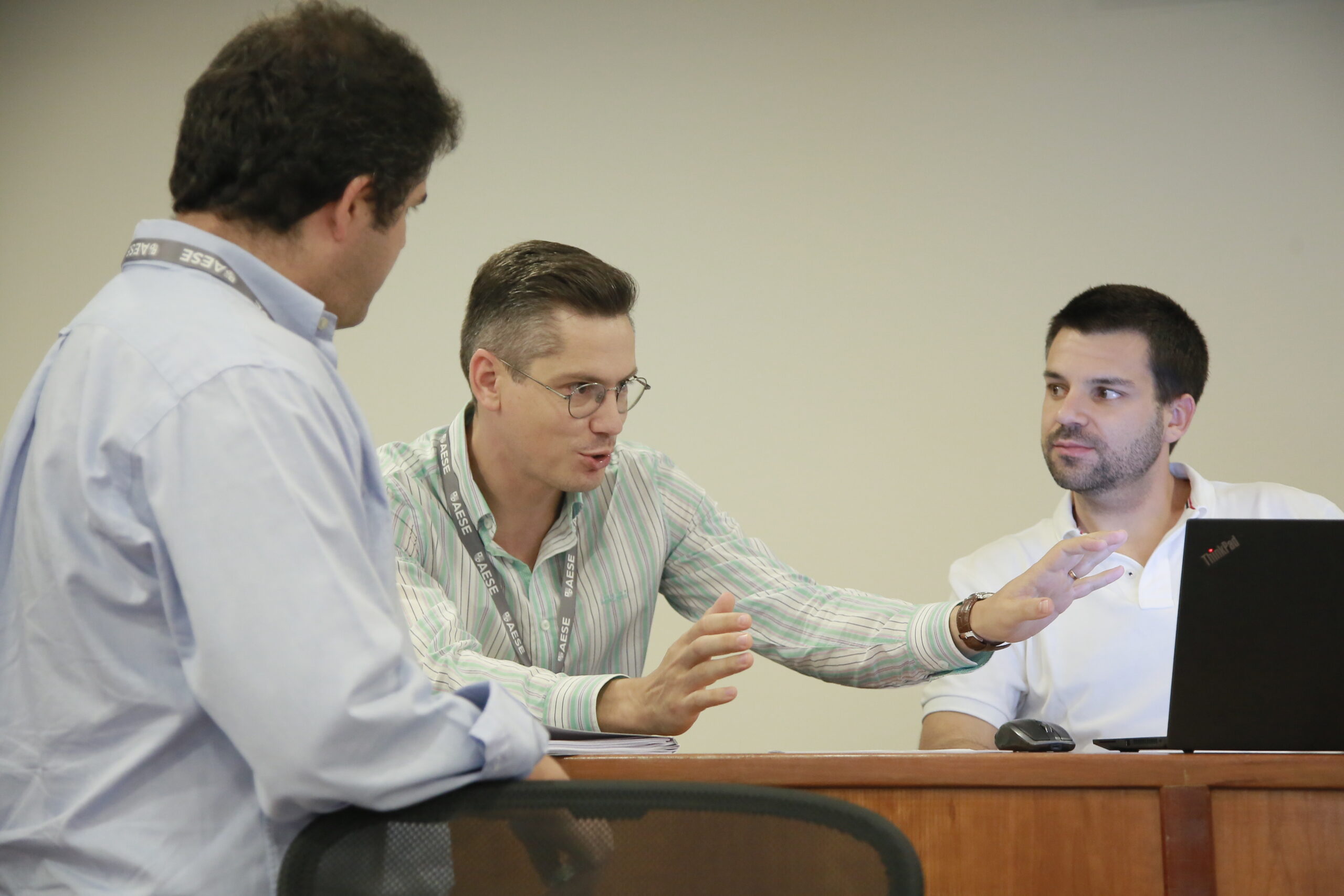
In the working group, the case is debated in a structured and rigorous manner. The different perspectives of participants—coming from distinct sectors, functions, and experiences—enrich the analysis and challenge assumptions.
In the classroom, ideas are tested, arguments are put to the test, and the consequences of decisions are explored. Participants learn both to defend a position and to recognize limitations and adjust their reasoning. With the professor’s support, the main lessons are systematized. The case does not close with a “correct answer,” but with more solid decision-making criteria that are transferable to professional reality.
In the Case Method, the professor is an orchestrator of the discussion, who challenges, questions, structures, and elevates the level of debate, ensuring conceptual rigor and analytical depth.
The Case Method is applied across AESE programs, adapted to the level of experience and responsibility of participants.
The Case Method

Why It Is Central at AESE
AESE has integrated the Case Method since its founding, in direct connection with the academic tradition of Harvard Business School and IESE. It is this methodology that supports the development of leaders capable of thinking with depth, deciding with judgment, and acting with responsibility.Real companies, practical dilemmas
For this active learning to be carried out rigorously, it is essential that the cases analyzed are of high quality. At AESE, we work with real companies such as Apple, Amazon, Lactogal, Sovena, Tesla, Unicer, to name a few, always bearing in mind that the data analyzed:
Case Writing at AESE
At AESE Business School, the case method is at the center of learning. Based on real situations, participants analyze complex challenges, discuss alternatives, and make decisions in contexts of uncertainty, developing critical thinking, decision-making capability, and responsible leadership.
In the Executive MBA and other programs, participants do not merely discuss international cases: they investigate real organizations, speak with decision-makers, analyze imperfect information, and write cases based on actual management challenges, always with rigorous supervision from AESE professors.
These cases—many developed within the Business Situation Analysis course—focus on Portuguese and international companies, with authorization from the organizations involved. They are used in AESE programs, often with the participation of the authors themselves and the companies’ decision-makers, enriching the debate with direct testimonies and practical reflection.
Case Study Examples

CASE STUDY
NOS Alive: Let there be Rock!
Commercial Policy and Marketing

CASE STUDY
A Grand Entrance?
Business Policy

CASE STUDY
From the Cork Oak Forest to the Cork, one business at a time
Commercial Policy and Marketing

CASE STUDY
Warren Buffett and Berkshire Hathaway
Commercial Policy and Marketing