

The leader is the one who has the ability to be continuously aware of his surroundings, to listen, to learn and to seek information.
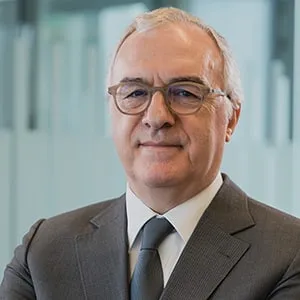
António Martins da Costa’s professional career includes positions of high responsibility at an international level.
Currently a Director of EDP, he took the PADE – Senior Management Program at AESE, which he highlights among the various training courses attended throughout his life.
As a leader, he seeks to “be continuously attentive to what surrounds him”, to know the current issues of greatest importance to the corporate world and to make good use of reason and emotion, not forgetting that ethics and aesthetics are essential to the personal nature with which he performs his duties.
What are the main milestones in your professional career that contributed to reaching the position of Director of EDP?
Firstly, the academics: the degree in Civil Engineering from FEUP, in 1976, the MBA from PBS, in 1989, and the various executive training courses I have undertaken, with emphasis on the PADE of AESE, the AMP of the Wharton Business School and, recently, the IDP-C of INSEAD. If the degree gave me the basic training, the MBA allowed me to embark on a different line from the one I had been following until then, entering the world of management, and executive training proved to be fundamental for updating and developing new visions.
On the professional side, the change, after the MBA, to the Millennium BCP Group, which was then starting, allowed me to become a Director of Seguros e Pensões – at the time the largest Portuguese insurance group, owner of Ocidental, Império, Bonança, Médis and Seguro Directo – and AF Investimentos, at the time the largest investment fund manager in Portugal. And later, when I returned to my home of origin, EDP, where I was Executive Director for fifteen years, during which I took on responsibilities of various responsibilities in the business units and in the corporate center.
But, across all this, my international journey was undoubtedly the most remarkable fact, with ten years (1999-2009) of professional activity and personal life in Poland and the Netherlands – in the Millennium BCP period – and in Brazil and the USA – in the EDP period.
What were your main achievements?
I would highlight three: the first, in the way I performed, between 1999 and 2002, my role as Executive Vice-President of PZU in Poland, the largest insurance company in Central and Eastern Europe, with a value of €2,500 million at the time, representing the private shareholder Eureko, a pan-European holding company, in which Millennium BCP participated. In an environment of intense institutional disputes between private shareholders and the Polish State – which had privatised the company, and which still held a majority position there – I managed to ensure the personal and professional respect of all parties involved, maintaining the balance between defending the interests of the company and those of the shareholder I represented.
Another, already in my new EDP cycle, with the IPO of EDP/Energias do Brasil, in 2005, a highly successful operation that placed the company on the Bovespa, with a value at the time of almost €2,000, after negotiations with minority shareholders, a corporate restructuring and a road-show with investors in the largest international financial markets. This even earned me the Executive of the Year award, as Executive Chairman of the company.
The third, with the success of the EDP Renováveis North America operation, where I was Chairman and CEO after EDP’s acquisition of a local developer in 2007, achieving that the company, in two years, positioned itself as the third largest renewable energy operator in the USA, operating in 29 states. It is today the main growth engine of the EDP group.
What are the main lessons that make you the leader you are today?
That the leader is the one who has the ability to be continuously attentive to what surrounds him, to listen, to learn and to seek information. And that with this he is able to form his own vision about the purpose and business model of the company he has to manage, to believe in it and to transmit it properly to all stakeholders, with ethos, logos and pathos, the three Aristotelian pillars of communication.
Equally relevant, the awareness and knowledge that the leader must have about the current issues of greatest importance to the corporate world, such as sustainability, social responsibility, good corporate governance practices, the importance of risk management and compliance, as well as about all the technological/digital transformation that is taking place.
And, in a more global view, to have the notion that, if the appropriate balance between reason and emotion is a determining factor for leading and managing, the ethical and aesthetic senses are an essential component of the way to put this principle into practice.
What values do you govern yourself by and that you transmit to your teams?
As a reference, the idea that a business business aims to create value for all its stakeholders. At the same time, highlight the role that each one has within the organization, its importance, and the relevance of what the company does to society. And the principles of the leader, who must know how to be demanding, but with the appropriate level of tolerance; knowing how to be the support factor, the motivator, delegating, but without ceasing to make decisions; know how to live with and promote diversity, be it gender, age, background, beliefs or individual capacity. Leading by example is believing that one of the greatest satisfactions a leader can achieve is to feel their teams functioning as such and see the growth of each of their members over time.
If you could go back in time, what would you do differently?
Little would change, but perhaps I can identify two situations. One, to understand that managing disputes is a process of permanent negotiation, where the reason that assists us is not always enough to obtain what seems obvious to us. In particular, when on the other side there are power relations that go beyond mere business logic. They are, therefore, notions that can only be learned through experience, or by listening to experienced opinions.
Another, in which, although it is always desirable to seek consensus in discussions and decisions to be made in corporate bodies, sometimes formal dissent is necessary, as long as it does not work as a blocking factor for the proper functioning of these bodies.
Professionally, how do you see yourself in 5 years?
Certainly in a new cycle, managing in a balanced way the different dimensions of life: professional, social, family, cultural, spiritual, among others. In the professional component, I hope to be working as a NED (Non-Executive Director), for which I have been certified in the INSEAD international program, where I can contribute my knowledge and experience, namely in international management. In addition, I also see myself maintaining other activities that I currently like to do, to enter into debates or give lectures in executive courses.