

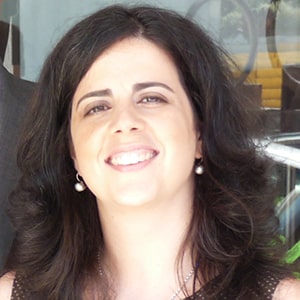
Able to reconcile the corporate world with social responsibility, Magda Matos, who is in charge of Performance Control at Lisbon Airport, takes on the mission of “making the world better”. She participated in the edition of AESE’s One Step Ahead in 2021 because she was looking for leadership training, with applicability in everyday life. “The OSA transmits to us concepts and practices that allow us to introduce small changes with immediate effects, which are expected to contribute, as a whole, to larger causes.”
Who is Magda Matos?
MM: First of all, he is someone who strives to raise the bar of the quality of the places he goes through and the projects he works on. Both at home and in the institutions where I passed, at an educational and professional level, they instilled in me the responsibility to, to the extent of my abilities, make the world better.
This involves, first of all, a constant search to do things with a sense of commitment and truth: in what I do and in the relationships I have. This purpose awakens my energy to go to the bottom of the issues, to understand what is behind them, how they are interconnected and what to do to find better answers. I have good planning skills and that starts with myself: I make sure that a yes I give to a request is credible, because I highly value building relationships of trust and meeting deadlines.
My background is in Management and so I have ease in the world of numbers, but also in letters (I almost followed Law). More importantly, I multiply myself to be available and cooperative. It is still in my nature to build bridges between different themes and people and help ideas become reality.
What are the main milestones in your professional career, which have allowed you to get to where you are today?
MM: When I left university, I started working, about three years, at Ernst & Young, at the time, one of the “big five” multinationals, (now EY). It was a great “school” that undoubtedly influenced the way I still develop my work today, namely in terms of critical thinking and ability to anticipate. It allowed me to have very demanding, diversified and enriching experiences, not only in terms of the sectors where I worked, which included, from the Gas and Electricity sector in Portugal to the diamond sector in Angola, as well as at a human level. Then I went to work for ANA – Aeroportos de Portugal. I started working in the Financial Department for several years and, along with working in various aspects of this area, I was immediately called to participate in several transversal projects of the Company, which allowed me to build a very broad vision of the business.
Of these, I begin by highlighting, due to its complexity, the privatization work of ANA. Before that, at the invitation of the Vice-President at the time, I was part of the team of 11 staff from different areas that developed and implemented the company’s application project for “Great Place to Work”, which resulted in ANA being recognized as one of the best companies with more than a thousand employees to work for
I have also been working in the area of sustainability: I started by being selected to participate in the 2nd edition of the Young Managers Team Program of BCSD Portugal (Business Council for Sustainable Development), I actively participated in the structuring of the then Social Responsibility and Sustainability Council of ANA, in the preparation of all published Sustainability Reports and in several relevant initiatives in this area. More recently, I was Godmother of one of the 15 winning projects of the first edition of the VINCI Program for Citizenship.
I cannot fail to mention the innovation project called “Airport of the Future”, of which I led the development of the respective business plan. This project, which aimed to rethink the various stages of the passenger’s journey from home to the boarding gate, inspired some relevant changes implemented at the airport. It was a multidisciplinary team in which, in my case, in addition to leadership and the economic perspective, I was invited to look at each stage from the passenger’s perspective. This perspective required the ability to put several areas into dialogue and, with this approach, obtain a consistent result. The side benefits were that I fell in love with the vibrant and complex world that is airports.
Later I received an invitation from the Lisbon Airport Management that I accepted and with whom I work directly. The Performance Control area aims to optimize the airport’s performance – “you can’t manage what you can’t measure” – while I am involved in a series of other projects. Among them are sustainable mobility in the airport perimeter, a topic that has been gaining increasing relevance, a corruption prevention project and responsibility for the Directorate’s Newsletter. This Newsletter aims to make all employees aware of everything relevant that happens at the airport. If under normal circumstances it is an important communication tool, in this phase of the pandemic, in which people have been more physically dispersed, it has been fundamental to maintain the connection between everyone.
Given your ability to “bridge” various areas, how did the passion of the lucrative business world and the world of social organizations come about?
MM: It can be said that the desire to share my time and talents with those who need it most is a family tradition. In my maternal grandparents’ house there was an annex that we called the “little school” (it was really a miniature school), where my grandfather, an engineer by profession, gave voluntary school support not only to the youngest members of the family but also to those who needed it most.
It was a mark that passed on to my mother who, in turn, went further and developed by choice all her professional activity in a social neighborhood, in the health area. I have no hesitation in saying that it has made a difference in the lives of many people. I myself started volunteering at a very young age in this neighborhood and this “bug” has always accompanied me over the years. More recently, I was invited to join, on a voluntary basis, the board of a Private Institution of Social Solidarity (IPSS). We are talking about an IPSS that serves more than 120 children up to pre-school age, of different nationalities and origins. History repeats itself: there I also contribute more actively in the financial area, but also in other matters. I don’t know if I give more than I receive, but the feeling I have is that I receive more than I give, with the immense amount I learn from this reality that systematically takes me out of my comfort area.
In this intersectoral dialogue, what are the main challenges that have been felt?
MM: First of all, in the case of IPSS, to be present and close in a reality in which I am not physically. The need to transpose to that reality a series of themes to which I am sensitized is also a challenge. In an institution where most human resources have a very homogeneous training, without prejudice to having very competent people, there is always room for improvement. Fortunately, I have found a lot of openness on the part of the other Board Members, with very different backgrounds from mine and with whom I have also learned a lot, which is half the way to success.
Another important component is the way in which priority setting is handled. Both realities are oriented towards the excellence of the service they provide. However, in a large company, profit orientation is intrinsically present and the perspective of long-term sustainability is visible. In an IPSS, the greater scarcity of resources sometimes leads to being more oriented towards daily management and the effect of each decision in the long term is not so intuitive.
How does OSA come about on your route?
MM: OSA came to respond to my desire, for some time now, to attend a leadership program, comprehensive in terms of time and skills. I am demanding in the institutions I choose to do training, where I try to have a high return between what I give and what I receive. I had already attended some short programs at AESE and I really enjoyed the experience and OSA, more extensive in time, seemed to me to correspond to what I wanted.
I have to say that from the first contact there was a good reception on both sides and a great harmony. So I was very excited about the idea of participating.
At the stage of your career, does the network provided by OSA bring you an advantage?
MM: Yes. I would even say that it is having a relevant impact at this stage, not only in my life in particular, but also in this time of pandemic, in which everything is questioned and there is an even greater predisposition to work on the ability to adapt and open horizons.
The fact that I am in contact in these weeks with professionals from other companies, from other areas, to share about how we are experiencing all this, what we are experiencing, how situations are being turned around, what prospects are glimpsed for the future… it is essential.
Do you recommend AESE’s OSA?
MM: Without a doubt it is. What I would say to any potential candidate who wondered about a female leadership program was not to be scared by “the ending” (it was a question I asked myself): it is constructive in the sense that we are women, with certain characteristics, that there are certain aspects that can be worked on, but there is nothing that cannot be heard by men.
It is versatile, because very current topics are addressed, some in which we are stronger and refresh and share knowledge, others that we have the opportunity to deepen in panels, conferences-colloquium and group work. I also highlight the mentoring aspect, which I felt as a mirror that reflects where we are and as a compass to guide us in the future.
“The OSA transmits to us concepts and practices that allow us to introduce small changes with immediate effects, which are expected to contribute, as a whole, to larger causes.”
What three lessons would you like to have received at the beginning of your career and that you could pass on to professionals who are just starting out?
MM: One of them is that our greatest quality can also be our greatest defect. You have to know how to season, just like an ingredient in cooking. It can be fantastic, but too much can spoil.
The second is that when others have a certain attitude it is not necessarily with the same intention that we would have. It doesn’t make everything acceptable, but taking into account that people don’t have the same history or the same way of being as us, helps us to relativize behaviors and avoid some pains along the way.
And the third is to know from an early age the existence of impostor syndrome. There are times when we are given unexpected challenges and the first tendency is to think that we are falling short. However, if we have, on the one hand, confidence in ourselves and, on the other, the awareness that, if someone invites us, it is because they have recognized in us the profile required for the position, we will have a greater capacity for discernment.
Have you always managed to reconcile work and family well, or was it a skill that you acquired over time?
MM: From an early age I learned to do good time management, as I have always had many activities beyond school (in addition to volunteering I also studied music, which also plays an important role in my life, and which required great discipline and planning skills). If I know what is expected of me, I can easily set priorities, organize myself and do everything in a timely manner. Difficulties often arise when I’m surprised by several important urgencies with the same deadline. At these times, justice be done: family and friends have played a fundamental role, by freeing me from some tasks in order to ensure the necessary availability for those who need it most.