

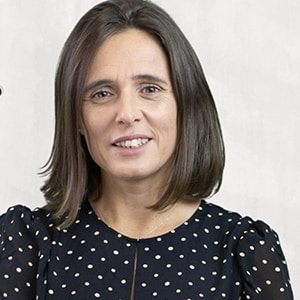
I don’t grow by doing a set of things well, I grow by being able to make a group of people grow.” This is the definition of leadership by Sílvia Nunes, a participant in AESE’s OSA, who would have liked to have learned this lesson earlier. The Director of Michael Page and Founder of the Profiler Podcast, explains the importance of reconciling professional and personal life to feel happy.
Who is Sílvia Nunes?
I am 43 years old, two children, two boys, I have a degree in Management.
I started by working on what was, in fact, my first big goal: to work in a completely financial function at PwC, one of the big consulting firms.
Then, I got a contact and an invitation to change my area completely and in 2005 I took on new functions, in this case, in Human Resources. I went to work for Michael Page where I am today.
In the course, I always thought that I would go into finance, that I would be financial all my life, but the truth is that during my experience at PwC, what was highlighted in my functions was never something of technical competence, but always what was the way I established relationships. And that’s what made me consider this move to human resources and I’ve been there for almost 17 years. So, my path is here, and what I really like is to work with everything that has to do with people.
And what are the main milestones of your professional life?
The first, effectively, was to have gotten it into my head that I was going to work at PwC and to have succeeded. Especially because, at the time, they told me that with the management course at the private university where I studied “people don’t even get in…”.
Then, I think that in everything in life it takes a little courage and I had everything to doubt this potential change from finance to human resources. What would you do? I had graduated in Management, in Finance. And, for me, it is a milestone to have had the courage to accept this challenge and to have realized, that regardless of whether my path was one, forward it will have to be another.
The milestone is perhaps this, of having had the courage to say yes to a project completely different from what I had thought of for myself until then.
The third is to have arrived today at the form or the capacity, the way I consider leadership to be and how I exercise it. In other words, the ability I have to exercise a leadership role is a very big milestone for me, because I come from an exercise of old-fashioned leadership, that is, much more austere, much more authoritarian, of someone who is up there and dictates instructions down here.
Working on that a lot, I’m very aware of the way I was working and I realized that that was neither the right way nor the way that made me feel happy. I was making the path much more adjusted to what I am, much more adjusted to this conciliatory and aggregating profile and that works for the benefit of what is a group of people that I want to work happily, motivated but, above all, feel in their day-to-day lives that they are learning, that they are developing a personal, professional and, of course, My growth will eventually come with that.
I don’t grow by doing a set of things well, I grow by being able to make a group of people grow. And then the paradigm changed completely radically for me.
The other milestone was this ability I had, with the help of course, to completely change my mindset related to leadership.
What is the relevance of professional training and personal development?
Everything. Honestly, I think all of it. Because throughout life, we always have to be permeable to learning. And learning can come through countless vectors, but specialized training is naturally one of them.
First, because of a need to update. I think it is a set of subjects and content that we learned back then and that are evolving, that we debate today in a completely different way. It is a matter of information, of updating, of curiosity, of updating what our knowledge is.
Second, because new ideas are effectively emerging, new ways of thinking that were not studied. And all of this complements what we do.
When we have been working for a few years and go back to studying, the return is completely different, because we can put themes in our day when we are learning and then we immediately take that learning to the day-to-day themes. There is an almost immediate direct correlation.
Learning is part of professional development, but it is also part of personal development, because neither of them is dissociated from the other.
If we have the opportunity, periodically, to propose to learn and, in this case, in a more specialized, more organized format, etc., I think it is gold on blue to be complemented with what is our professional development and our personal development.
Is it with this mindset that your podcast project emerges, to which you invite inspiring people?
The podcast is a personal project. For many years I thought: “what a shame that I’m the only one in this meeting, listening to these people talking”, because I always work a lot on the concept of sharing, sharing in various formats.
If I know, I have to transmit it and if I don’t know, I have to know someone who knows for me to access that information. The more we share, the more information flow there is, the more other people are more informed and everything will be much more positive.
It is on this concept of sharing that the content of “Profiler” is based, which is the podcast I started doing in January, where I sit down to talk to strangers – as I usually say -, people who have made professional careers and who have reached where they are whatever it is. That is, I don’t invite people because they have function A or function B. I invite people who have a content, a path, a path that is differentiating, who have worked hard to achieve it and today are happy to do what they do. It is this path that makes those stories an inspiration for those who can listen to us. That is how this idea that I have been developing came about. I already have more ideas to take this format to other instances.
Have you always felt happy reconciling work with family, or have you learned to do it over time?
I need both to be genuinely happy. If I’m just more dedicated to my family and neglect my work, immediately my children will feel that they have a less fulfilled mother at home. And the opposite is exactly the same. If I have my family at a less stable time for whatever reason, that is immediately reflected in my performance.
This conciliation is really necessary, because for me these sides are not separate. I think they are intrinsic with each other and one does not exist without the other.
I think it requires a lot of organization, a lot of will, and I think I can do this conciliation for two reasons: the first, because I have a lot of support to be able to do it and I think that this support is fundamental. There were times when I didn’t ask for this support and things didn’t go so well, so I think we should raise our hand and ask for help. I was in superwoman mode and didn’t need anything. This is completely false, we always need help, even when we don’t ask for it, help is always welcome.
The second factor is because I recurrently do an exercise of awareness to understand how I have or don’t have this balanced. Sometimes, we think we reconcile, but it is a very false conciliation, because seen from the outside, there is nothing balanced. Therefore, I do it, because I really need to know if I am reconciling in a balanced way, or if I am leaning more to one side or the other, and if there are reasons or not. This happens occasionally, but we always have to try to adjust.
How did OSA come into your life? And how has it contributed to transforming your career?
OSA came into my life because I have the privilege of working in a company that identifies this type of training and proposes it to employees. I was lucky, with some colleagues, to be called to analyze this syllabus to validate if it made sense for us at this stage of our career. Naturally, in this environment the content was a unique opportunity, we saw that it made perfect sense and three colleagues came.
And then it came in a curious way, in the sense of the way I have been available to do the OSA. We can sign up for all the training, but if we don’t actually come with the predisposition to drink as much as we can, then it’s much less useful than it could be. And, therefore, what I highlight in the OSA has to do with this.
For now, we are “forced” to stop and be. I think that’s extraordinary, to have a training that forces us to stop and have our heads here, at 100% and prepare the contents.
Then, the way we stop to think. The case method is an extraordinary way of approaching the issues, because I am not taught a certain subject today and I will work on it tomorrow. The path is exactly the opposite. I start working on it alone, then I discuss it in a group with other OSA participants and, finally, the specialist or the teacher arrives who will explain how it is, how it is treated, what the requirements are, how everything is coordinated. It’s a completely opposite path to what I was used to until then: the message stays and endures.
I think the way OSA is coming into my life is really transformative.
Were your expectations being exceeded?
My expectations were exceeded, in the first place, by the method of the case, which I find extraordinary. Then, in the relationship between teachers and students. It is very easy to access teachers, to turn the presentation of a subject into a conversation, to debate parallel themes that end up joining the one that is the core of the session. There is a lot of scope in the content. We can talk, intervene, debate. It’s not a teacher teaching a class, it’s a conversation with a wide variety of participants. I think that gives us a lot.
Then, the group itself. The group brings a set of experiences, sharing, thoughts, ideas completely different from ours and everything together has a better result. This requires from each of us, an adaptation exercise and if we have been in companies for a long time, we no longer do this exercise. Here too, I think it surpasses. It was by working together, from day one, that we just met.
And then, the expectation of what remains, what we actually learn, in a way that feels almost unstudied. I acquired knowledge, but I wasn’t exactly sitting down studying. It was based on very practical, very pragmatic exercises, with very little theory.
For me, for my way of being, of working, this makes a huge difference and that’s why it exceeded my expectations.
How is the network developed throughout the Program?
These trainings are also a way for us to expand our networking network. But coming and meeting people is not in itself expanding the networking network. We also have to be here and interact with people, talk to them, get to know them, understand what their areas of expertise are, what their type of know-how is. Because networking is worth a lot to us to be able to turn to, or for people to be able to turn to us. Identify our skills in order to unblock, to unblock situations in our day-to-day. I don’t know, but I know who knows. I met a person at OSA who I know has mastered this subject, or I know that person I need to reach out. It is being available to be with people, to get to know them, to listen to them and then transform this into our day-to-day lives, into an effective network, which has a bilateral relationship and can last over time.
These trainings are genuinely a great source of networking. I am talking about the participants, as I am talking about the people at AESE, the teachers who in some way can facilitate us, can help us, can improve us.
What are three lessons you would have liked to have received at the beginning of your career?
The first is that what we study is a set of tools for whatever we want to do in our day-to-day lives. In other words, we are not hostages of what we study, we are not hostages of our academic content.
This was something I learned later, when I decided to quickly change areas and where I was questioned a lot.
The second is that when we have an effective conviction that something is the best for us, we have to seek it supported by the opinion and help of the people around us that we consider we should have in the various aspects of our life.
There is an exercise that I think we should do and that I suggest you do, and that is to always have an almost updated matrix of who are the two, three people who can help me with a task. Whether it is a professional issue, or more of a personal issue.
Have a very clear idea of who our support network is in a wide range of articles. If I need help in an area with marketing, I will ask these three people for help. If I need help in an area of finance, I will ask for help from those. If I need it on any other topic, I know who I have to turn to.
Having this support, this type of advice minimally guaranteed, I think we have to be convinced of what we think is actually best for us, after we have been properly supported and have the courage to assume it.
You can’t go back and know what it would have been like if I had done it differently, but I would probably be much less happy if I had continued in the world of finance and it took a lot of courage on my side to assume that this is indeed my path. The lines don’t have to be straight.
Third, leadership is far from being an authoritarian mission, from being someone who is up there and who dictates two or three measures down here and things appear done. I think it took me a long time to learn this, that a leader is a conciliatory and aggregator profile that makes things happen. That is not focused on itself, on its growth, on its merit, on its achievement of results. A leader is one who manages to make a group of people move, who brings them together, who reconciles them, who unites them, who trains them, who motivates them, so that this group makes good things happen. Leadership is a consequence of what we do to others. And no, a consequence of what we do to ourselves. This is not only the easiest, but the smartest and most win-win way to reach out to others.
This type of teaching should be an academic programmatic content, because younger people are taking on more and more roles and coordinating a person is leading, it is leading others but it is leading ourselves. Of course, there is a set of values, attitudes, which comes from education, from the family, because the school does not do everything, but in order to integrate the professional world, for this approach to active life, this type of learning should be done from the beginning.
Do you recommend OSA?
I recommend OSA, of course. The method of the case, the proximity between teachers and students, the group of people who know each other, the opportunity we have to expand, to work even more on our network are factors that all together, make it easy to learn.
I think we have to come predisposed to work, to learn, to listen. The way in which the know-how is passed, the close relationship between teachers and students, the group of people and then, also, the way we are able to retain the practical side with which the training of the content is chosen, I think that all this together makes a difference. It is impossible not to make a difference.