

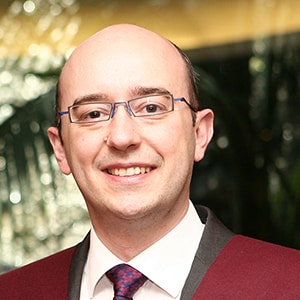
People, Business and Innovation are the 3 pillars in Filipe Janela’s personal and professional trajectory. Roche’s Business Director – Centralised & Point of Care Solutions, highlights humility and the willingness to learn and share knowledge as determining factors for “creating extraordinary relationships of trust that project us towards successes, which, at the outset, seemed impossible to achieve.” He believes that integrity and respect for solid values determine a complete leader capable of mobilizing resilient, supportive and committed teams.”
In 2012, his path crossed with that of AESE, having received the Executive MBA diploma. Asked about the future, he imagines himself “connected to a multinational context, technology-based, with a strong social impact, in the Health, Energy and Mobility sectors.
What are the main milestones in your professional career that contributed to your position as Business Director – Centralised & Point of Care Solutions at Roche?
My professional career is strongly marked by three major components that have decisively marked my trajectory: People, Business and Innovation.
People, for the privilege that has been learning every day from the professionals with whom I have worked and for the possibility of challenging them at every moment to think differently, to build valuable solutions and to develop their professional and human skills.
Business, in a comprehensive perspective of what it represents as an economic activity, a factor of development and social contribution. I have been developing this perspective throughout my career, but I must highlight the completion of the AESE MBA (10th edition), as a decisive moment to, as a leader, develop this holistic view of business activity and its social contribution.
Finally, Innovation, the incessant search for knowledge, for adding value in each simple task I perform, and for mobilizing those with whom I work for an attitude of constant search for excellence, value and innovation.
The consolidation of these three components make me the professional, the leader and the human being that I am today and that I consider decisive in the development of my career.
What were your main achievements?
As main achievements throughout my career, I would summarize them in two main aspects. On the one hand, the different successes, goals and recognitions achieved throughout my career for the fact that I dare to think differently and, with that, build with my teams solutions that are also highly differentiating, which have allowed us to achieve unique business successes.
On the other hand, the constant development of the people I worked with, which led them to achieve new goals and new stages of career development. I feel privileged that, throughout my career, I have crossed paths with many fantastic people, with whom I have been able to work in their development, both in terms of professional skills and in their more human plan, enabling them to evolve in an outstanding way in their professional careers.
What are the main lessons that make you the leader you are today?
As main lessons, I would highlight the humility to continue to learn every day and have the availability to share this knowledge with everyone around us, making organizations and their people increasingly stronger and more sustainable. In the same line of thought, I would highlight the possibility of surrounding ourselves with people who challenge us, who complement us and, with that, create extraordinary relationships of trust that project us towards successes that, at first, seemed impossible to achieve.
What values do you govern yourself by and that you transmit to your teams?
Very clearly, I have integrity and trust as fundamental values of any leadership and team management process. Only by being leaders with integrity and based on a very consolidated structure of values, can we be complete leaders and team mobilizers. Confidence, as a catalyst for extremely resilient, supportive and committed teams, inducing exceptional performances.
If you could go back in time, what would you do differently?
The decisions we make are the result of a certain framework and circumstances, so I don’t know if I would do anything differently. However, I would leave, more as advice, a reflection precisely on the most appropriate time to carry out the AESE Executive MBA. Based on engineering training and, at the age of 28, assuming a management position for the first time in the company where I was, I felt a clear need to learn and train myself in areas such as finance, strategy, HR management, corporate organization, among other topics, which led me to take the Executive MBA at AESE.
However, looking back today, and considering the model of the case and sharing experiences with the other colleagues who characterize AESE’s Executive MBA, I often wonder if, with that age and experience, I may not have done the MBA a little early. Given the richness of the discussions in the group work and in the plenary sessions, coming from the contents discussed but, to a large extent, from the sharing of more experienced colleagues, I am not sure that I have fully explored and made the most of that experience, as an alternative to taking the MBA a couple of years later. The reflection remains.
Professionally, how do you see yourself in 5 years?
Possibly, I will continue to be linked to a multinational context, technology-based, with a strong social impact and that operates in sectors that attract me a lot, such as Health, Energy and Mobility.